Where Art, Science, and Story Meet
I am an internationally recognized interdisciplinary artist, naturalist, and conservation communicator working across drawing, print-based imagery, installation, sound, live laser projection, field research, mapping, and strategic design. My practice explores migration, biodiversity, ecological memory, climate change, and the complicated relationships between humans and the more-than-human world.
My work often begins with a species, but it rarely ends there. I am interested not only in what an animal looks like, but in how it moves through a larger living system: the habitats that sustain it, the other species it depends upon, the borders it crosses, and the cultural histories, environmental policies, and political decisions that shape its survival. I use art to follow those connections outward and to make scientific research feel intimate, emotional, and alive.
At the center of my practice is What Still Sings?, a long-term and evolving body of work following migratory species and the landscapes that connect them. The project began with birds traveling between Alaska and Asia and has expanded through field-based artistic research in Mexico, Thailand, Colombia, the Brazilian Amazon, and other ecologically significant regions.
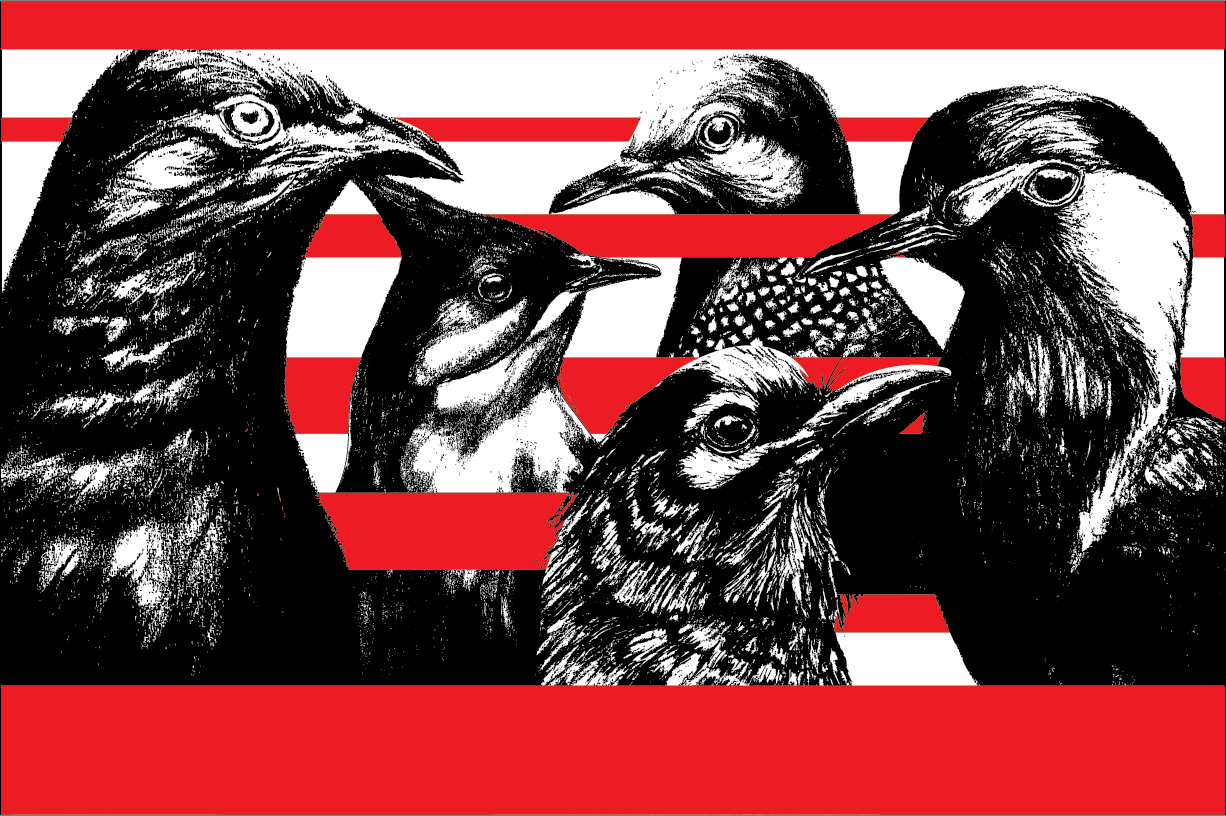
Through large-scale drawings, graphic print-based imagery, field recordings, original music, storytelling, mapping, and live laser projection, I create immersive works that make migration feel less like a line on a map and more like a lived, precarious, extraordinary journey. Each location becomes a connected chapter rather than an isolated project; part of a larger inquiry into movement, memory, adaptation, ecological loss, and the relationships that persist across political borders.
My background has always moved between disciplines. I grew up in New York and Pennsylvania and earned a degree in political science, with additional degrees in studio art and integrative media. My early academic interests centered on environmental policy and visual communication, but I wanted to understand how those ideas operated beyond the classroom. After moving west, I worked in conservation with the California Conservation Corps and the U.S. Forest Service, gaining firsthand experience in landscapes shaped by wildfire, water, public access, government decisions, ecological change, and the physical labor required to care for them.
I later moved to rural Alaska, where I spent years working for the National Park Service and U.S. Fish and Wildlife Service at Katmai National Park and Preserve, Alaska Peninsula and Becharof National Wildlife Refuges, and Arctic National Wildlife Refuge. Across my roles as a park ranger, educator, artist, media specialist, and public-lands communicator, I worked alongside biologists, land managers, educators, local communities, and cultural partners to translate scientific research and complex environmental issues into publications, exhibitions, interpretive programs, educational resources, and public stories.
I flew into remote communities, followed wildlife research in the field, watched bears fishing along the Brooks River, listened for birds across the tundra, and learned the seasonal rhythms of places where environmental change is impossible to ignore. Those experiences gave me a practical grounding in ecology, animal behavior, environmental policy, interpretation, and science communication that continues to shape the way I approach my artistic research.
They also taught me that facts alone are rarely enough. Information matters, but people are often moved to care through curiosity, humor, recognition, wonder, grief, and a sense of relationship. My work tries to create that point of entry, the moment when a species stops feeling distant or abstract and becomes part of a story someone can recognize themselves within.
The migration routes of whales I first encountered in Alaska eventually brought me south to Baja California Sur. Animals I had known in northern waters were traveling through, breeding within, or returning to the coastlines and lagoons of Mexico. Following them changed my understanding of place: Alaska and Baja were not separate worlds, but distant points along the same living map.
That realization became foundational to my practice. In Baja, my work has grown to include whales, seabirds, mangroves, coastal development, marine conservation, and the communities whose lives are connected to the sea. In Thailand, Colombia, and the Brazilian Amazon, I am extending the same inquiry through migratory flyways, amphibious landscapes, river systems, sound, light, local knowledge, and the movement of species through places undergoing profound ecological change.
I approach this work with the understanding that arriving somewhere does not make me an authority on it. My research is grounded in close observation, scientific literature, field experience, and collaboration with people who know a place more deeply than I do. I am interested in non-extractive ways of working: listening before interpreting, acknowledging local knowledge and place names, building relationships over time, and allowing complexity and uncertainty to remain visible in the finished work.
One of my longest-running independent collaborations is with explore.org, part of the Annenberg Foundation, where I work as a creative strategist and artist. My role brings together scientific interpretation, live wildlife observation, public engagement, campaign strategy, and visual storytelling for a global audience. For several years, I have helped shape the creative direction and visual identity of Fat Bear Week, translating the lives and seasonal transformations of Katmai’s brown bears into an accessible international conservation story. The campaign received both a 2026 Webby Award and a People’s Voice Award in Sustainability & Environment.
I was also selected as the featured artist for World Migratory Bird Day 2021, creating the international campaign artwork representing major global flyways and the birds connecting continents. My artwork and design have been created for national parks, wildlife refuges, conservation organizations, scientific initiatives, educational programs, and public exhibitions. Projects include the illustrated Katmai Junior Ranger program, Journey to the Ice Edge, Arctic National Wildlife Refuge’s Arctic Bird Fest, and collaborations with the National Park Foundation, Environment for the Americas, the National Parks Conservation Association, the Katmai Conservancy, explore.org, and the U.S. Fish and Wildlife Service.
My work and the international projects I have helped shape have been featured by The New York Times, The Washington Post, Rolling Stone, BBC Breakfast, CBC, Popular Science, Inverse, and She Explores.
I am also a birder, diver, traveler, rafter, and relentlessly curious observer. As a visually impaired visual artist, I often experience wildlife first through sound, movement, silhouette, and proximity before I can see its finer details. That has made listening central to my practice, not only listening for birds, whales, water, and changing weather, but listening for what a place reveals when I stop trying to immediately define it.
I do not see art, science, conservation, policy, and communication as separate fields. My practice exists in the space where they overlap. Science gives greater depth to wonder. Art can make research intimate. Storytelling can transform migration, habitat loss, extinction, and climate change from distant concepts into experiences that feel immediate and personal.
“We are not separate from the song”